4.2.3What is the FTC?
The Fundamental Theorem of Calculus
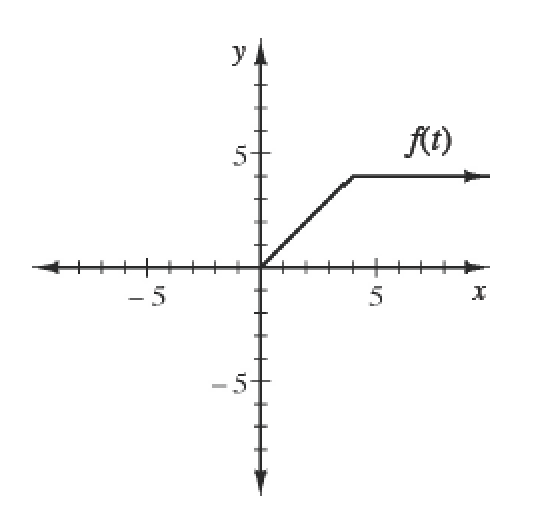
Anita is calmly sketching horizontal lines in her notebook when she notices a pattern among the area functions under horizontal lines. For example, the area function under the line
If
, write the equation for . If
, write the equation for . If
, write the equation for . If
, write the equation for . Examine the area functions you wrote in parts (a) through (d). How are they the same? How are they different? In particular, how are they all related to the original function
?

Tommy knows that this integral can be evaluated with
. Unfortunately, he does not know the equation for . Thinking about her answer to part (e) of problem 4-65, Anita suggests finding some function whose derivative is equal to . Tommy objects. “I can think of more than one function like that!”
What is Tommy talking about? List four functions whose derivative is
. In other words, list four different antiderivatives of . “Don’t worry, Tommy,” says Anita in a calm, comforting voice. “You can use any of those antiderivatives!”
Try it. Each member of your team should choose a different antiderivative for
and use it to evaluate . Compare your results. Tommy and Anita are delighted by their fundamental discovery. They now have a procedure to calculate the exact area under the curve of any function! “From now on,” announces Tommy, “I will not worry about the constant when evaluating a definite integral. I will write my antiderivative with a
instead.” Explain why all area functions lead to the same result when evaluating a definite integral.
Use Tommy and Anita’s technique to evaluate
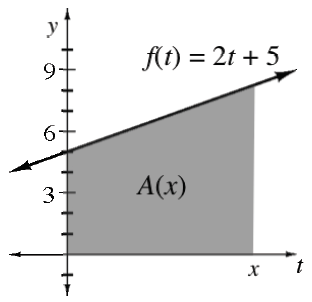
Use geometry to write an equation for the area of the shaded region in the graph at right.
That is, what is? What is
? Compare it to the original function. Part (b) shows that the derivative of an area function is the original function. Test this idea on a general linear function,
, by determining and . Does the same result happen?
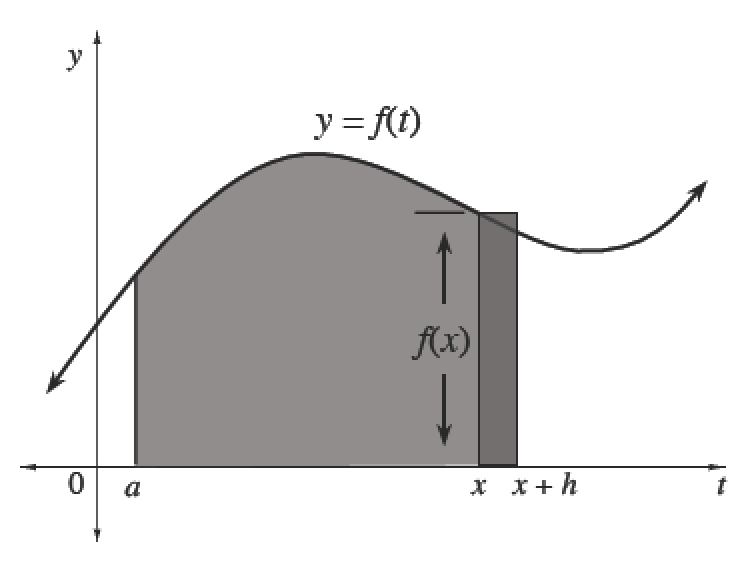
Start by examining the dark gray rectangle in the diagram. As
, what does that dark gray rectangle represent relative to ? Write two different expressions that can be used to calculate the area of the dark gray rectangle as
. One expression should use a familiar geometric formula and the other should use an integral. Do not forget that each expression must include the limit as . Note—neither of these limits should be evaluated, yet. Since both expressions in part (b) represent the same area, combine them into a single equation.
Knowing that
represents the antiderivative of , use the method developed in problem 4-66 to evaluate the integral part of your equation. Algebraically maneuver your equation so that one side represents the derivative of
in limit form. Recall that a limit as is often used to define a derivative. Be prepared to explain your result to the class. Evaluate the limits.
Using your answer to part (f), what does
equal?

Indefinite Integrals
Unlike definite integrals, which are defined between two bounds, indefinite integrals have no bounds and are written in the form
The indefinite integral
Example:
Note: Not every function has a closed form antiderivative.

Rewrite the following integral expressions as a single integral. Homework Help ✎
Keily put his dog on a diet! If
.png)
The graph of a function
Where (if anywhere) does the derivative of
not exist?
.png)
The graph at right shows the velocity of an object over time defined by the function
Use your graphing calculator to evaluate
. What does the result in part (a) calculate?
What does
represent? What will the units be in part (c)?
.png)
If
Given
Compare how distance and velocity are related with these two scenarios: Homework Help ✎
As an arrow flies through the air, the distance it has traveled in feet at time
is given by . Without your calculator, determine the velocity, , at times and seconds. Explain what concepts of calculus you applied in order to solve this problem. As a train travels past a station, its velocity, measured in miles per hour, is
. If the train is directly across from the station when , determine the position of the train at hour. Explain what concepts of calculus you applied in order to solve this problem. Parts (a) and (b) both involve distance and velocity. However, each required a different method or approach. Describe the relationship between distance and velocity, as well as the derivative and area under a curve.

If
is an odd function and , evaluate: 4-77 HW eTool Homework Help ✎ If
is an even function and , evaluate: